With Washtenaw County voters approving a new 10-year county-wide millage to fund Career Technical Education (CTE) on November 4, the question now is how this moves forward as taxpayers begin supporting the expansion of CTE learning experiences from preschool through high school graduation.
CTE is defined as an educational approach where students learn by doing, combining traditional, rigorous academic concepts with practical and technical skills. With CTE, students can explore their interests and skills and then eventually match them to high-wage, high-skill, in-demand career pathways.
The CTE millage will be used by the Washtenaw Intermediate School District (WISD) to reimburse all local public school districts for existing CTE expenses and to also develop new countywide CTE learning opportunities. The millage is projected to raise over $25 million in 2026. School districts throughout the county, such as Dexter, Chelsea, Saline and Milan, are expected to see the benefits of this millage.
The WISD gave an update recently to give a timeline about the millage. One important detail to note first is that funds from the CTE millage will not be collected until this summer tax collection, which means the funds will not be available for distribution until the 2026-2027 school year.
The first step happening during this current school year, called Phase 0, has the WISD meeting with leadership from all nine districts in the county, as well as with postsecondary and community partners, using a project management approach.
From there the next steps include:
- Build capacity for new programs and systems through staffing, professional learning, and exploratory work in new pathways.
- Launch a CTE countywide advisory and governance structure.
- Operate pilot programs through grant funding.
- Create a millage transparency webpage to host equity metrics.
The first millage funds will be collected in July 2026. And then in the 2026-27 school year, the WISD will finalize a countywide CTE consortium agreement, and begin maintaining and expanding new programs from recent pilots. In that year, the steps will also include sustaining existing programs, launching new programs to address immediate waitlist concerns, and purchasing equipment as necessary. The WISD will also explore and pilot PreK-12 career exploration opportunities and conduct site visits to education and industry exemplars.
In year two, which will be the 2027-28 school year, you will begin to see such things as the full implementing of new high school programs and career pathway opportunities at district, regional, and countywide levels.
And then in year three and beyond, the millage will help do such things as build a robust work-based learning infrastructure for students while also effectively communicating opportunities and successes with students, families, and community partners.
There are many other steps at each phase, so to learn more about CTE in Washtenaw County, visit washtenawcte.org.
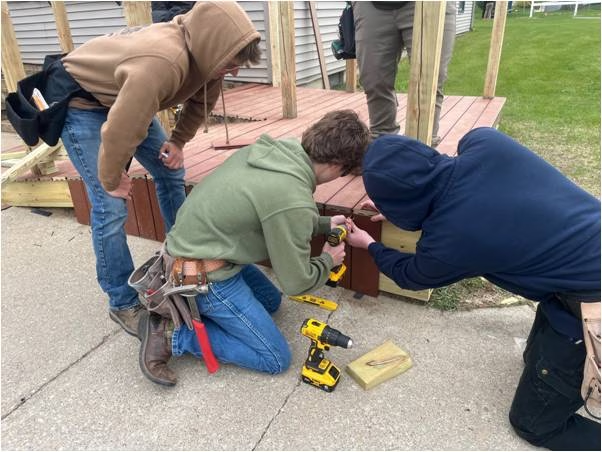
Photo: CTE students in the Construction program put in upgrades at school building last year in Dexter. photo by Lonnie Huhman





 8123 Main St Suite 200 Dexter, MI 48130