Photos by Cynthia Furlong Reynolds
An elegant woman dressed in black and wearing an open-crown straw summer hat with a jaunty bow and gold high heels pulls hatbox after hatbox after hatbox out of her car.
“I have more, of course,” she says, handing over armfuls of the huge wallpaper-covered boxes. “In fact, my living room is decorated with towers of hatboxes—and they’re full.”
Hats. Hats. And more hats!
Balmoral Bonnets. Berets. Bicorns. Boaters. Cloches. Cartwheels. Dolls. Pancakes. Pillboxes. Picture hats. The Fez, Fanchon, and Flowerpot. Halo hats. Half hats. Not to mention the Tyrolean and Turban. Some have broad brims, some have visors, some have no brims. Some are plain, relying on their fine fabrics and lines for effect. Others are decked with artificial flowers, ribbons, bows, veils, half-veils, feathers, and/or faux jewels.
On October 19, between 2:00 and 4:00, Diane Hall will model these—and many more hats at the Dexter Area Historical Society’s meeting in the museum.
Hat aficionado Diane Hall is a retired IT specialist who is also a genealogist, vintage dancer, dressmaker, more-than-amateur historian of fashion and films, and storyteller. She has a wealth of lore about family members and film stars and their triumphs and tragedies that otherwise would have faded into history.
“I have an appreciation for older things,” she says, opening the first hat box with the look of a child opening a big Christmas present. Choosing the first chapeau, she studies her reflection in a mirror as she positions a broad-brimmed black straw number properly on her shoulder-length white hair.


“My paternal grandmother, Vina (nee Whitlow) Hall, grew up on a farm in Tennessee, in a Southern Baptist family,” she says when she turns around. “To her, women were supposed to be demure, modest, teetotalers, supportive of their husbands and families, and well-dressed. That’s how I was raised, by people two generations ahead of me.”
When Diane moved to Ann Arbor in 1984, she discovered the Treasure Mart, a treasure trove of antiques and collectibles that long-time thrifters still mourn and miss.
“The Treasure Mart was a revelation,” she says, switching to a half-halo hat lined with white fur. “On my first visit, I picked up a hat there and it reminded me of playing dress-up with my grandmother’s hats when I was a small girl. The memories came flooding back. Almost every time I went, I found elegant hats, originally very expensive, for six or eight dollars, and I couldn’t resist rescuing them.”
At about the same time, her dermatologist studied her fair, porcelain skin and told her, “I don’t want you to go outside without sunscreen and a hat.”
“I realized that hats looked as fantastic on me as they did on a shelf,” she says. She began collecting in earnest and sewing outfits to match. Every week she chooses a different hat for church—or everywhere else.
“My Aunt Agnes had an MFA and always dressed marvelously,” Diane recalls. “She designed and sewed her own clothes, including matching coats, and she often covered her shoes with matching fabric. Of course, she wore hats and gloves and jewelry to complete her ensemble. She looked like a fashion model! I began having fun doing the same.”
***
‘Most women don’t know how to wear hats properly,” Diane Hall observes, as she looks into a mirror while carefully positioning an Edwardian Picture hat on her head. “These hats were worn by ladies who wore corsets, and for all their negatives, corsets gave women great posture. A woman can’t help but keep her back straight, her shoulders down, and her head high when she has a corset on.” That perfectly describes her own posture.
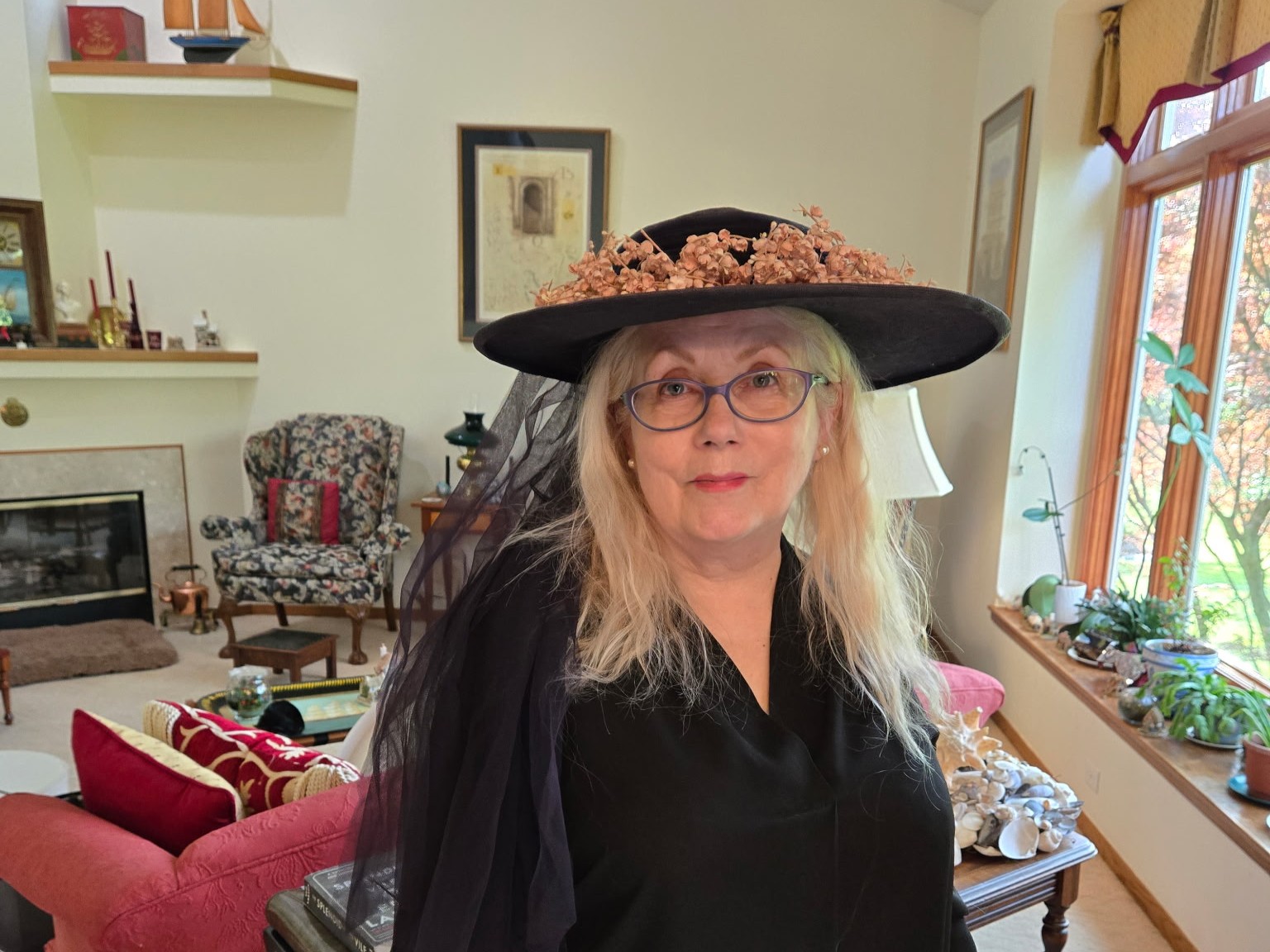
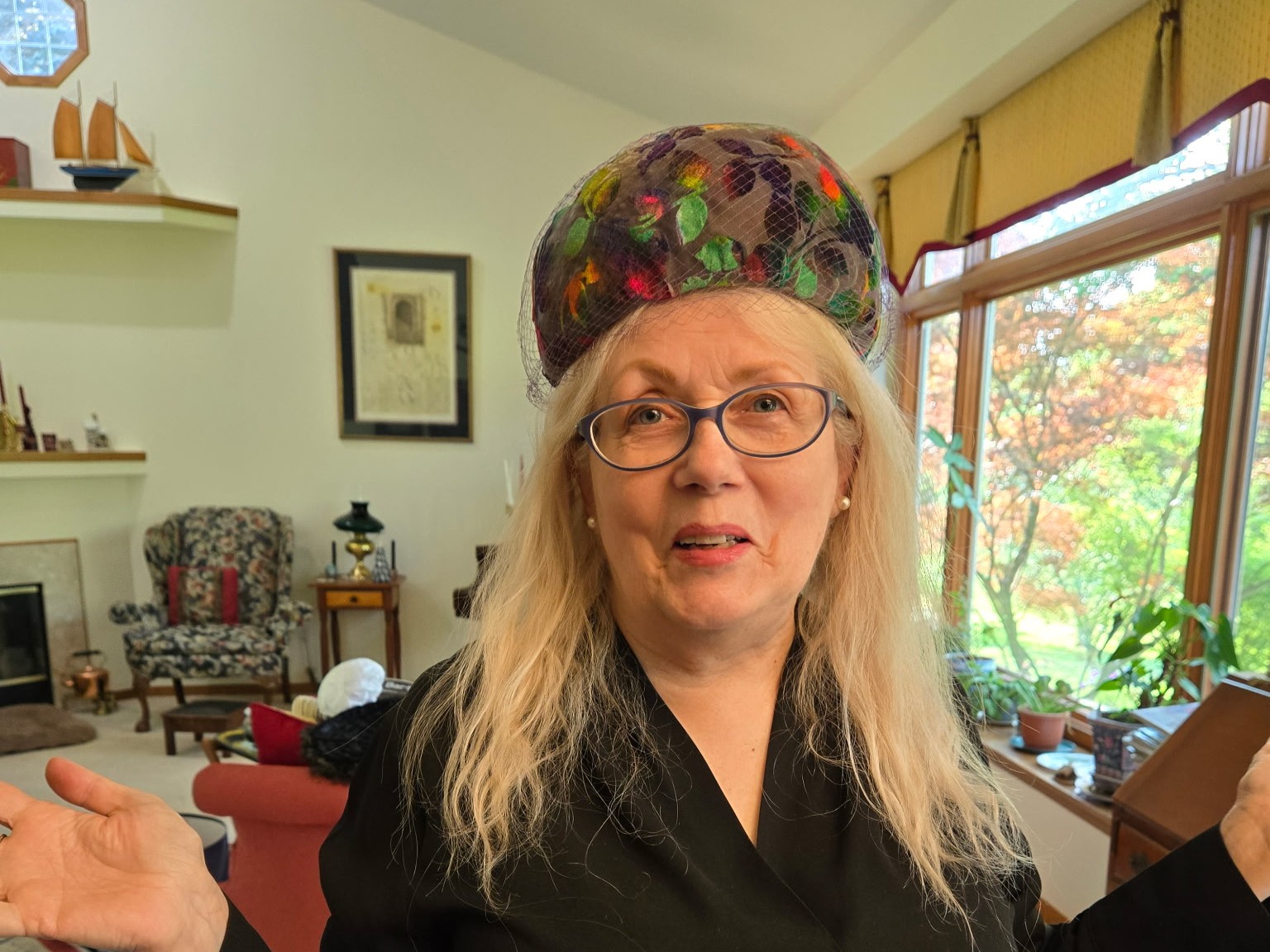
Throughout human history, hats have served a variety of functions: from practical to symbolic. Ancient gravesites have been unearthed to find skeletal remains with identifiable traces of headwear. For members of the upper classes, hats indicated wealth, rank, and position—social, military, economic, and ecclesiastical. Clergymen, craftsmen, and military men wore hats that indicated their professions and their levels within those professions. Aristocrats wore hats to symbolize their rank and wealth. But for the average man and woman, hats were practical ways to keep the hair clean, the head warm, and sun, snow, and rain out of their eyes.
Hat fashions changed dramatically in Western Europe and the Americas in the 1860s, when parasols were introduced. No longer did upper-class women need to worry about keeping the sun off their complexions and the rain off their heads. Hats lost any need for practicality and became ornamental fashion statements.
Headwear was immensely important to fashion-conscious women through the 1950s, and just when their use began waning, Jackie Kennedy brought the pillbox and veils back into style. In 1983, however, the hat industry sounded a death knell when the Catholic Church decreed that women parishioners no longer needed to wear head coverings. At the same time, the feminist movement and a freer lifestyle relegated hats to members of royalty.
In this century, Catherine Princess of Wales renewed public interest to head coverings—“but I don’t regard fascinators the same way I regard a well-made hat.” Diane dons a burgundy favorite with netting and feathers. (“Six dollars from the Treasure Mart.”)
She especially admires the hats from the Edwardian period—”the early days of Downton Abbey,” she explains while adjusting the veil on a wide-brimmed Picture hat. “In earlier times, veils hid a woman’s face for modesty and privacy—and always for mourning. But by the late 19th-century, veils became smaller and flirtier—a ‘come-hither’ look” rather than a ‘don’t-look-at-me’ message.”
As the fashion show continues, she says she admires hats for their particularly fine fabrics, shapes or accessories, but her favorites are those that resemble the elegant hats worn by actresses in her favorite classic movies.
“Audrey Hepburn is my all-time favorite, of course—no one can top her fashions in Breakfast at Tiffany’s. I’m also fond of Myrna Loy’s Doll hats in The Thin Man series. The hats reflect her film personality beautifully—sassy, frivolous, and up-for-fun and adventure.”
She also admires His Girl Friday star Rosaline Russell as makes a grand entrance into Cary Grant’s newsroom. She strides in, wearing an outrageous suit and “wacky” matching hat, holding her head high. “With a hat and outfit like that, everyone knows she is supremely confident, the best at what she does.”
She adds, “I looked far and wide for a hat like that. And then I made myself a matching ensemble.”
While she began amassing her hat collection, she happened to be walking downtown one summer evening when she heard 1920s’music. She followed the rhythms to the Bird of Paradise, where she saw people dancing to the music her grandparents once played on the Victrola. “A friend danced past the window and motioned me in. That’s how I was pulled into a vintage dance group—the Grand Traditions Vintage Dance Group. It changed my life! Suddenly everything—my love for hats, my sewing, my passion for fashion and dance—all came together.”
The group holds a Christmas ball and a Ragtime Ball, among others, and members are encouraged to dress in facsimiles of clothing from different eras. “I started really getting interested in period clothing then,” Diane says. She traveled to Prague for a week of vintage dancing lessons. “Some of my relatives were from Bohemia, so the dancing, the music, and my family heritage were all bonuses when I was there.
“I love dancing! I’m a natural follower.” “But,” she adds mournfully, “I don’t dance as much now—most of my friends were older than I am, and they’ve either died or they no longer dance.”
She dons an original Caroline hat, dark green, dating from the Nineteen-Teens. It looks something like a pillbox, but with decorative items on either side. “I bought this in a vintage store in Williamston for thirty dollars. Originally it must have cost between $400 and $500.”
She repairs vintage hats, if necessary, and occasionally makes her own hats for a special dress. Years ago, when she acted in community theater, she not only wore hats for her roles, but supplied them to the cast. And she’s been known to loan hats for friends’ occasions.
Recently, Diane’s hat collection had its first (pardon the pun) unveiling, when she was asked to give a presentation to the Webster Township Historical Society’s annual tea. The teenage waitresses had a marvelous time modeling. “It was so much fun! And I’ve had other groups invite me to speak.” She says she is spending the summer researching and cataloguing her collection.
“To me, the rescuing and wearing of these hats is a way of paying respect to the people who wore them and their way of life. We owe them a share of gratitude as our forebears,” she says, reluctantly stowing her last treasure back in the last hat box.
For information about the program, visit https://www.dexterhistory.org/




 8123 Main St Suite 200 Dexter, MI 48130