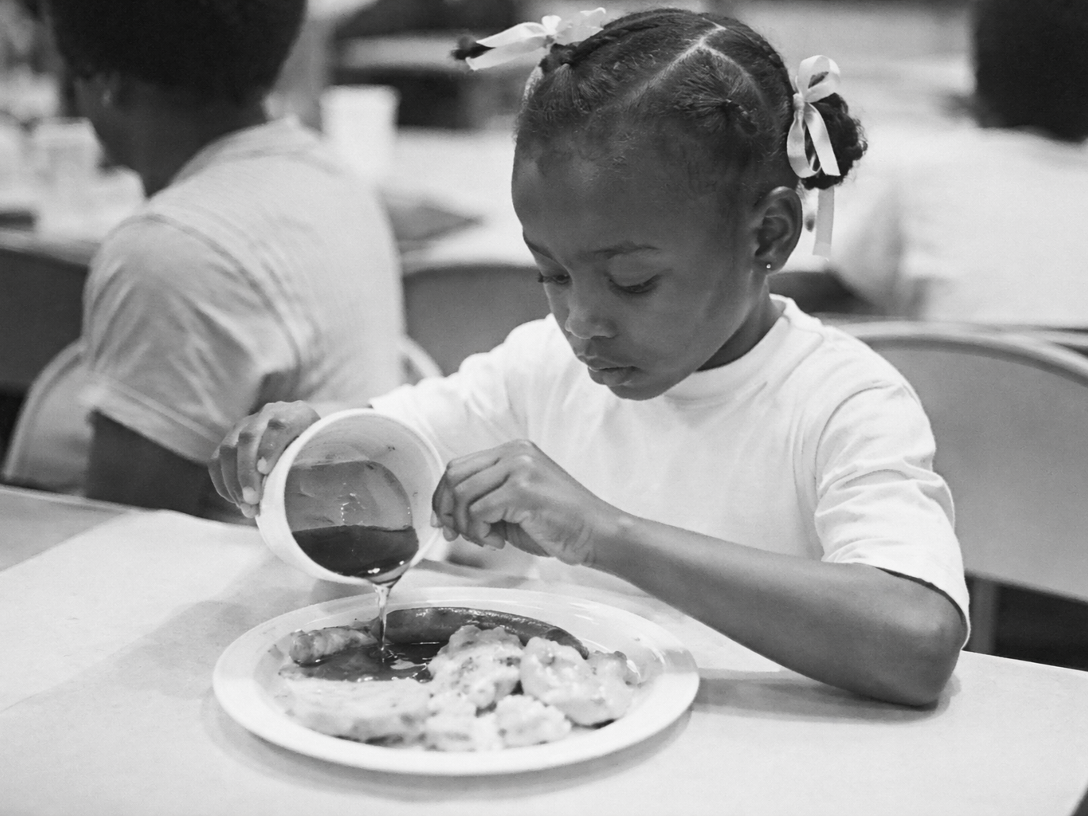
Author’s note: This article is published as part of Black History Month and examines one aspect of the Black Panther Party’s history. The Black Panther Party was a complex and often internally divided organization whose history includes both community service and armed confrontation with authorities. This piece focuses on its social programs, particularly efforts to feed children that influenced federal policy.
The Black Panther Party is often remembered for its militant imagery of leather jackets, berets, and armed patrols confronting police. But as historian Alexander Rhea documents in The Origins of the Black Panthers: Untold Stories of Power and Resistance, that image masks the deeper and more impactful reality of the Panthers building one of the most effective grassroots social service networks of the 1960s, and in doing so, reshaped national policy.
Far from being defined solely by protest, the Panthers developed programs that fed children, delivered healthcare, and cared for isolated seniors. According to Rhea, the federal authorities ultimately viewed these initiatives as more threatening than street demonstrations.
Who Were the Black Panthers?
Founded in Oakland, California, in the mid-1960s, the Black Panther Party emerged in response to persistent police violence, economic exclusion, and government neglect in Black neighborhoods. While public attention often focused on their confrontational tactics, Rhea emphasizes that the organization quickly expanded its mission beyond protest.
Rhea writes, “The Panthers launched survival programs in direct response to conditions they witnessed daily: children arriving at school hungry, families without access to affordable medical care, and elders living in isolation.”
Their goal was not symbolic resistance, but practical survival and, eventually, self-determination.
“The material aid also exposed structural inequality to a broader public, turning private suffering into visible evidence of governmental failure,” says Rhea.
Misrepresentation and Government Response
Local and federal law enforcement framed the Panthers primarily as a criminal threat. According to Rhea, this framing was strategic. Surveillance, arrests, and publicized confrontations allowed authorities to portray the organization as dangerous rather than civic.
“Programs like free breakfasts, health clinics, and political education were portrayed by some officials as instruments of radicalization instead of community support. This allowed police to justify surveillance and interference under the guise of public safety. Describing social services as subversive minimized public sympathy…” writes Rhea.
That misrepresentation intensified once Panther programs began producing tangible results. The more the Panthers demonstrated competence and reliability, the more seriously they were treated as a political challenge.

Feeding Children, Building Power
The clearest example was the Free Breakfast for Children Program, launched in Oakland in January 1969 at an Episcopal church.
At the time, the Black Panther Party was widely portrayed in the news media as a militant organization and viewed with suspicion by many Americans. But for the students who lined up for breakfast each morning, the Panthers’ political ideology mattered far less than the simple fact that they were being fed.
As Erin Blakemore documents in How the Black Panthers’ Breakfast Program Both Inspired and Threatened the Government, school officials quickly noticed changes among students who received breakfast before school. “The school principal came down and told us how different the children were,” said Ruth Beckford, a parishioner who helped with the program. “They weren’t falling asleep in class, they weren’t crying with stomach cramps.”

“Within months the Black Panther Party helped establish dozens of breakfast sites in major cities, using schools, churches, and community centers as meal locations,” says Rhea.
These programs were not sporadic acts of charity. They operated on a daily schedule and reached thousands of children. All the while, the underlying “purpose was to fuel revolution by encouraging black people’s survival,” writes Blakemore.
“This scale reflected deliberate logistical planning: sourcing food, coordinating volunteers, and developing simple menus that could be prepared reliably each morning. The program’s geographic reach also created a national example, inspiring similar efforts by other grassroots groups and drawing attention to both hunger and community-based solutions,” writes Rhea.
The visibility mattered. Parents saw uniformed volunteers delivering consistent care, and trust followed. The breakfasts emphasized the Party’s dual mission of immediate relief and broader social mobilization.
What appeared to many as a simple act of charity drew intense scrutiny from federal authorities. FBI Director J. Edgar Hoover viewed the Black Panther Party’s free breakfast program as a direct challenge to law enforcement efforts. In 1969, he described it as “potentially the greatest threat to efforts by authorities to neutralize the BPP and destroy what it stands for,” and authorized broad measures aimed at dismantling the initiative, documents Blakemore.
Federal efforts to shut down the breakfast program were swift. FBI agents went door-to-door in cities such as Richmond, Virginia, warning parents about the Panthers, while in San Francisco, families were told the food was contaminated. Police raids followed in Oakland and Baltimore, and in Chicago, officers photographed children attending the program.
Blakemore documents, “The night before [the first breakfast program in Chicago] was supposed to open,” a female Panther later recalled, “the Chicago police broke into the church and mashed up all the food and urinated on it.”

Though these tactics eventually disrupted the Panthers’ efforts, the visibility of the programs had already changed expectations. As children became accustomed to free breakfasts, political pressure mounted. While the USDA had piloted breakfast programs since the mid-1960s, national expansion followed in the early 1970s, right about the time the Black Panthers’ breakfasts were disrupted. The School Breakfast Program was permanently authorized in 1975.
Today, that national framework is visible locally. Dexter Community Schools, along with Chelsea, Milan, and Saline Area Schools, offer breakfast programs to students through the Michigan School Meals program, demonstrating the principle promoted by the Black Panthers that children learn better when they are not hungry.
Health Clinics and Care for Elders
The Panthers applied the same operational logic to healthcare that they used in their food programs, establishing community clinics in neighborhoods with limited or mistrusted medical access. Volunteers provided basic exams, immunizations, prenatal monitoring, and health education, with an emphasis on prevention and practical care. Clinics also trained community members, ensuring that skills and knowledge remained even where facilities were later shut down. That model of care extended to seniors through organized meal delivery and regular visits to elders living on fixed incomes, addressing both hunger and isolation. Together, these efforts reduced immediate health risks, alleviated loneliness, and reinforced the Panthers’ role as reliable community caretakers.
“For many seniors, these visits reduced hunger and loneliness while building trust in the Panthers as community caretakers,” writes Rhea.
Why This Was Seen as Dangerous
Rhea’s analysis makes clear that these programs were not peripheral to Panther politics. They were the strategy.
“In essence, the Panthers used care as governance training, blending moral obligation with tactical statecraft to prepare communities for sustained autonomy,” says Rhea.
This was precisely what alarmed federal authorities. Feeding children, providing healthcare, and caring for elders demonstrated that alternative systems could function and that legitimacy could be earned outside state control. Caring for the immediate needs of people won their hearts.
The Legacy Today
The Black Panther Party’s relationship with government authority was often confrontational and, at times, violent, marked by surveillance, raids, arrests, and internal divisions that ultimately contributed to the organization’s decline. Those conflicts remain a central part of its history and cannot be divorced from the broader record of the movement.
At the same time, the Panthers’ social programs left a measurable imprint. By meeting immediate needs, they exposed gaps in public services, drew national attention to child hunger and healthcare access, and demonstrated that community-based systems could operate at scale.
As Alexander Rhea documents, these efforts “created a template for sustainable scale.” Today, school breakfast programs, community health centers, and senior meal delivery services operate nationwide, separated from their radical origins but shaped by the same principles of accessibility, consistency, and trust.
The Panthers’ legacy, then, is neither singular nor simple. It includes both confrontation and care, resistance and administration, and serves as a reminder that some of the most consequential political acts have taken place not in legislatures or courts, but in cafeterias, clinics, and neighborhood kitchens, a reminder that some of the most powerful political acts begin with feeding a child before school.
Sources
- Rhea, Alexander. The Origins of the Black Panthers: Untold Stories of Power and Resistance.
- Blakemore, Erin. How the Black Panthers’ Breakfast Program Both Inspired and Threatened the Government
Featured photo: Girl eating at a community meal organized by the Black Panthers, Chicago, IL, 1970. Library of Congress





 8123 Main St Suite 200 Dexter, MI 48130