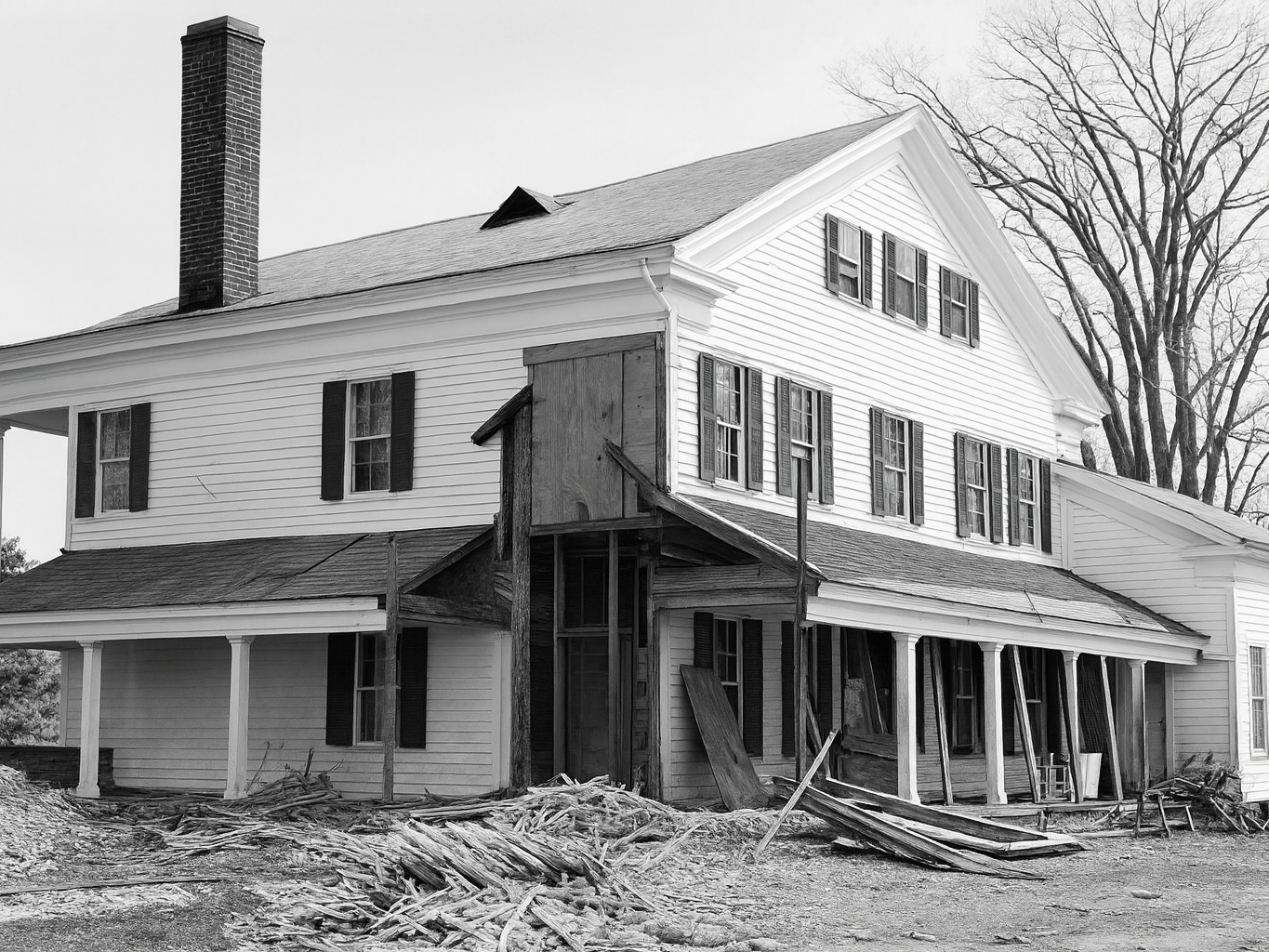
Editor’s Note: Katharine Dexter McCormick, the granddaughter of Dexter’s founder, Samuel Dexter, was born on August 27, 1875, in Dexter in Gordon Hall. During her life, she made a significant impact on women’s equality in the areas of suffrage, birth control, and education. To commemorate the life of one of our own on the 150th anniversary of her birth, the Dexter Area Historical Society has written a series of articles to share her amazing story with you.
The symbolic home of the city of Dexter, Gordon Hall, has a long and storied history. Built for the Samuel W. Dexter family between 1841 and 1843, this classic Greek Revival mansion stands on a rise west of Dexter, surrounded by stands of mature trees and farmland. Its Greek Revival architecture draws its beauty from ancient Greek temples, complete with columns, symmetry, and simple, open interior layouts featuring tall windows and doors. A central hallway cut through the center of the structure, creating a sense of airiness and space.
Emil Lorch, a nationally known architecture professor at the University of Michigan (UM), had contacted Katharine and told her of the mansion’s vacancy and subsequent deterioration. He, along with U.S. Senator Royal Copeland (a native of Dexter), convinced her to purchase the home in the hopes that this important structure could be saved. Katharine purchased the house in 1939.

Katharine was married to Stanley W. McCormick, who was the son of Cyrus H. McCormick, inventor of the grain reaper and founder of the International Harvester Company in Chicago. Stanley passed away in 1947, leaving Katharine with a vast fortune, several houses, and large tax obligations.
Hoping to ease her tax burden, with the advice of her lawyers, she donated Gordon Hall to the University of Michigan in 1950 with the stipulation that it be used for faculty housing. In 1951, the UM Regents Meeting minutes state that The Regents accepted with grateful thanks to the donor, the property known as Gordon Hall and the surrounding seventy acres, together with $86,000 from Mrs. Katharine Dexter McCormick (Mrs. Stanley McCormick), of Chicago…
The minutes continue: The house, originally constructed for his home by Judge Dexter, is now being rehabilitated. The present plan calls for alterations to provide four apartments and the plans presented by the Plant Department have the approval of Mrs. McCormick. It is estimated that the alterations and improvements may cost $60,000 and that a four-car garage will cost in the neighborhood of $5,000. Katharine also stipulates that her gift should cover the cost of maintenance of the grounds.
The university almost immediately set to work preparing the house for construction by removing the Northwest Ell, ripping out the original interior walls, central hall, and staircase. Katharine had approved the plans presented to her as the terms of her gift stated, although there is some speculation that she may not have fully known what she had signed. The apartments were to be used by retired university administrators and staff. Alexander Ruthven, president of UM from 1929 to 1951, lived there shortly after the apartments were completed. His name is still on the apartment door buzzer at Gordon Hall.

Meanwhile, the drastic interior changes occurring at Gordon Hall did not go without public comment. The UM Regents’ Meeting minutes from March 1951 record that a letter was received and placed on file from the Monroe County Historical Society relative to Gordon Hall and its use by the University. The Board then instructed the University News Service to prepare a comprehensive statement of the terms and conditions under which the property was received by the University for distribution to the newspapers of the state.” This article ran in the Dexter Leader on April 5, 1951.
At the same time, an article in The Home Newspaper in Detroit was published, indicating that the mansion had some famous supporters. Ulysses S. Grant III – grandson of President Grant – stated that as president of the National Council of Historical Sites and Buildings, he did not hesitate to urge its preservation on behalf of the organization, as he feared the proposed construction plan would harm its cultural value.

Other detractors of the UM plan were Fiske Kimball, director of the Philadelphia Museum; G.H. Edgell, director of the Museum of Fine Arts, Boston; and Mrs. Donald E. Adams, president of the Historical Society of Michigan. The Detroit Institute of Arts also weighed in, as did the Detroit Historical Society. The university’s plan went ahead regardless, but to this day, the objection to the reconfigured interior continues to rankle locals, historians, and architects alike.
The University of Michigan approached Katharine again in 1955 to acquire funds to build two houses on a portion of the Gordon Hall property near the mansion, again to house retired UM faculty and administrators. She advanced the University $50,000 for this purpose. The homes were built, one of brick, one of wood. Each had the same floor plan, with a large living-dining area, three bedrooms, a utility room, an attic, and a garage. These houses continued to be rented until they were torn down by the historical society in 2008.

The U of M briefly considered selling lots on the vacant, triangular-shaped 70 acres that surrounded Gordon Hall, and even drew up plans for a uniquely designed subdivision. According to the June 15, 1955, edition of the Dexter Leader, it was expected …that eventually something like 50 homes will be built on this property. The plan at this time for the design of this property is to build homes in circles, approximately 6 to a circle and 8 circles.
The houses would be of a variety of types and styles, and would be not only UM housing, but would invite homeowners in other professions to buy there as well. The housing project would be called Dexter Estates. The plans never came to fruition, allowing Gordon Hall’s beautiful grounds to remain intact.





 8123 Main St Suite 200 Dexter, MI 48130