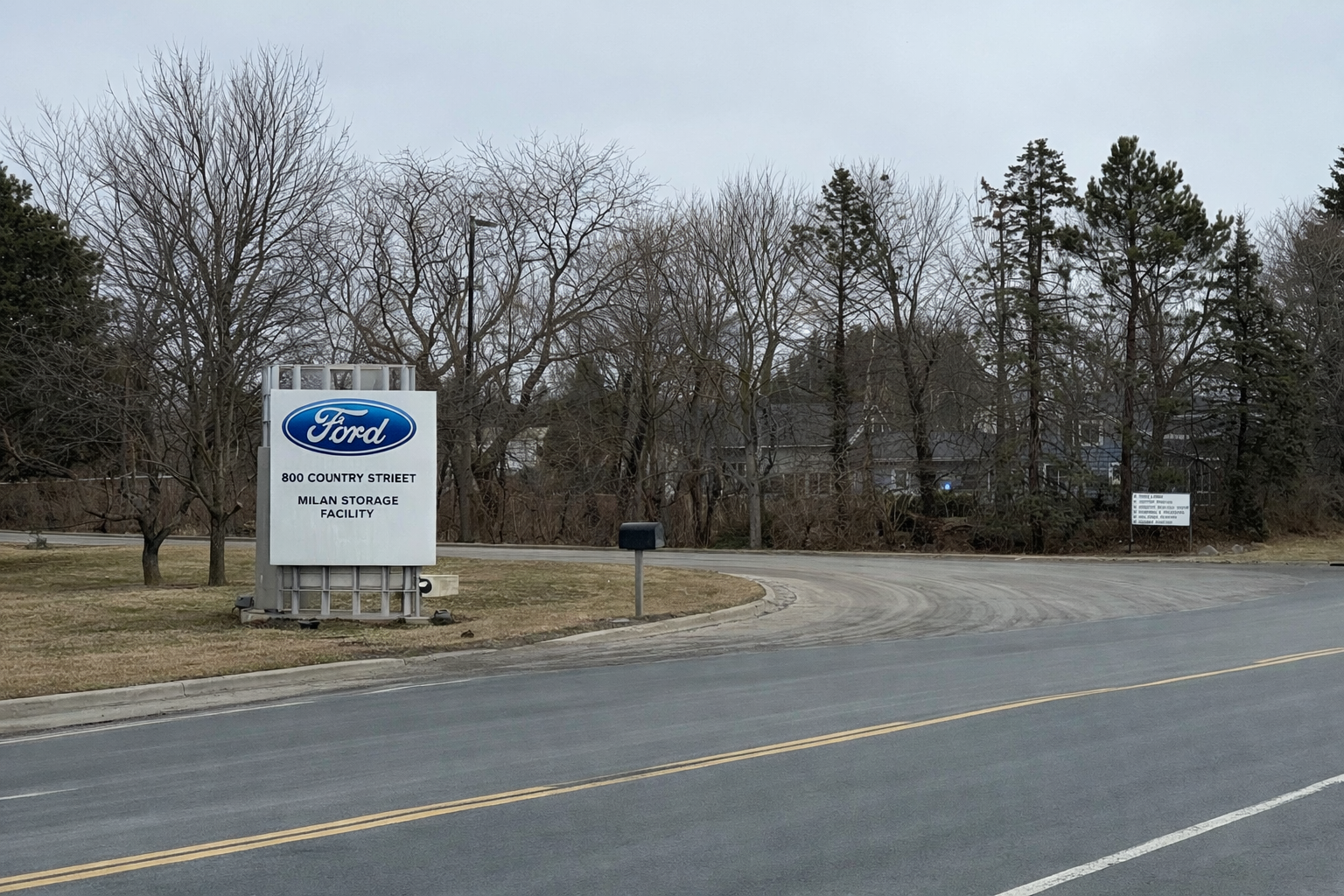
State regulators are investigating per- and polyfluoroalkyl substances, known as PFAS, detected above Michigan cleanup criteria in a groundwater monitoring well at the former Ford plant site in Milan, but officials say there is no indication the contamination has affected municipal drinking water or nearby private wells.
PFAS Detected in One Monitoring Well
The Michigan Department of Environment, Great Lakes, and Energy confirmed that PFOS and PFOA were found in a monitoring well identified as MW-13 on the property.
The highest concentrations were 39 parts per trillion for PFOA and 30 parts per trillion for PFOS. Michigan’s groundwater cleanup criteria are 8 parts per trillion for PFOA and 16 parts per trillion for PFOS.
According to EGLE, the detections were limited to one well screened in the shallow aquifer beneath the site. Monitoring wells in the deeper aquifer, which is used for drinking water wells in the area, showed no detectable PFAS. Data reviewed by the agency indicate the contamination is not moving off-site in the shallow aquifer.
Milan City Administrator Jim Lancaster said the city was notified earlier in February about potential findings at the site.
“Our response to them was that we are very interested in anything related to this site and the impacts that it will have on our community as a whole,” Lancaster said, referring to EGLE.
He said the city has not received additional information since that initial notification but understands the state remains engaged in the investigation.
Ford first sampled groundwater for PFAS at the site in 2022. EGLE later determined that sampling event was affected by cross-contamination, meaning PFAS was detected in quality control blanks. That issue may have caused results to appear higher than actual conditions.
The company resampled groundwater monitoring wells in 2024 and 2025. EGLE received those results in September 2025, confirming exceedances of PFOA and PFOS in the same monitoring well.
Ford did not respond to a request for comment before publication.
Sampling to date has primarily focused on groundwater. One surface water sample collected from a pond on the property showed PFAS levels below Michigan cleanup criteria, the agency reported.
Although data did not indicate that PFAS had migrated off-site, EGLE conducted residential well sampling near the property as a precaution. The agency sent sampling requests to 11 nearby residents in January. Three homeowners agreed to participate. All three wells were sampled in February and showed no detectable PFAS.
The City of Milan’s public water supply is on an annual monitoring schedule for PFAS, and testing has shown no detectable levels.

Investigation Ongoing Under Federal Oversight
The former Ford plant is regulated under the federal Resource Conservation and Recovery Act, which governs hazardous waste cleanup. In Michigan, the program is administered under Part 111 of state law. EGLE indicated that Ford is conducting a facility investigation to determine the full extent of contamination at the site, including PFAS, metals and volatile organic compounds.
Once the investigation is complete, a remedy will be selected. The timeline depends on whether additional testing is required.
More information about the site, including investigation updates and data summaries, is available through the state’s PFAS response website at:
https://www.michigan.gov/pfasresponse/investigations/sites-aoi/monroe-county/ford-milan
The facility is locatated at 800 County St., Milan, MI 48160

Featured image: A sign marks the former Ford site in Milan, recently added to the state’s PFAS response database. Photo by Heather Finch





 8123 Main St Suite 200 Dexter, MI 48130