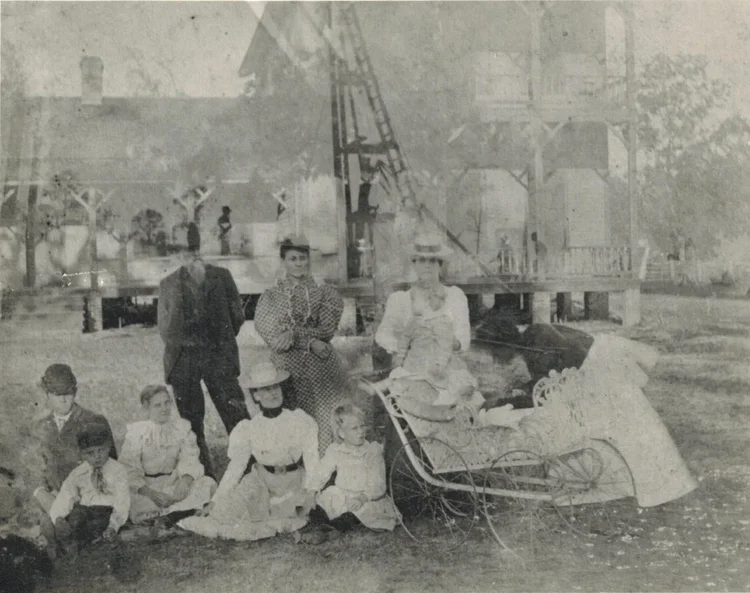
In her new book, Leslie Stainton documents kidnapping, abuse and racial violence embedded in her family’s plantation history.
Editor’s Note: February is Black History Month, a time to reflect on the history of slavery, racial injustice and the ongoing struggle for equality in America. This article is part of a series exploring how national Black history connects to local institutions and individuals, including members of the University of Michigan community, and how those legacies continue today.
A Night in an Enslaved Cabin
One night not so long ago, Leslie Stainton unrolled a sleeping bag on the wooden floor of a cabin that once housed enslaved workers. The sixth-generation descendant of one of the South’s largest slave-holding families was on a personal quest: to excavate the truth behind her family’s tales of idyllic antebellum plantation life.

Questioning the Family Myth
It was not a comfortable night—for many more reasons than a hard floor. The University of Michigan professor, who has a background in public relations, was ripping away the Scarlett family’s rosy images of Southern belles, gallant cavaliers, and happy cotton-pickers. Actually, she learned, her family’s huge antebellum cotton empire was founded on kidnapping, rape, cruelty, greed, lawlessness, and misogyny. “And the stories have a direct connection to modern-day racism,” she says.
From Family Lore to Historical Record
At the start of Black History Month, Stainton’s no-holds-barred tell-all, SCARLETT: Slavery’s Enduring Legacy on an American Family, was published, to acclaim. “I want readers to know the truth about plantation life. Gone with the Wind is an absolute lie.”
It wasn’t easy to remain objective and reveal shocking family secrets, she admits. “But once I started researching slavery, I realized the truth had to be known, no matter how shameful or painful to my family. As I wrote, I felt I was uncorking a lamp and having Aladdin appear.”
SCARLETT has been a long time in the making. From the time she was a child, Stainton (who was raised north of the Mason-Dixon line) knew that her Georgia-born grandmother, Mary “Mamie” King Hilsman Pettigrew, was collecting materials and stories related to the family history in Glynn County, Georgia—most of which the Scarletts owned, along with more than 500 enslaved persons. In fact, Margaret Mitchell named her heroine after the Scarlett family, as she admitted to Mamie.
Stainton speculates that Mamie’s obsession with family history was based on recurring childhood nightmares based on a night when the women of her family waited fearfully for Scarlett men to return from a night raid—“typical of a lynching.”

Documents Tell a Different Story
Mamie spent decades collecting Scarlett genealogy, tales, and documents—even the documents that didn’t reflect well on the family. “I think she wanted to believe in the antebellum South of Gone with the Wind, but she also gave me Fannie Kemble’s 1863 powerful anti-slavery narrative Journal of a Resistance on a Georgia Plantation—which portrays terrible abuses. And perhaps she wanted me to discover the truth she couldn’t face.”
After writing a biography of Federica Garcia Lorca and Staging Ground: An American Theater and Its Ghosts, Leslie Stainton was ready to tackle her grandmother’s project. To do so, she participated in the Slave Dwelling Program, visited archeological sites on former Scarlett lands, combed state archives, wills, census reports, voting rolls, and newspaper accounts, as well as Scarlett documents: ads offering to purchase enslaved “Negroes” or seeking trackers to chase enslaved people who had fled Scarlett plantations, shipping manifests for runaways, correspondence documenting the escape of two dozen enslaved people in 1863, and a “Freeholders’ Agreement” from 1868, dictating the harsh conditions under which freed African Americans were to work if they lived on Scarlett lands after the war.
She uncovered horrific stories related to people she had been taught to admire.
Kidnapping, Violence and Forced Labor
Fifty years after Congress banned the importation of slaves, a Scarlett purchased an African prince from one of the last illegal slave ships, which arrived at nearby Jekyll Island in November of 1858. “Records show that they tried to make him an overseer, but he didn’t cooperate, so he was severely beaten, then rented out to neighbors as a producer of slave children, for $100 a day—yes, there were breeding plantations throughout the South, I was horrified to learn.”
The Scarletts’ closest neighbor, the Butlers of Jekyll Island, enslaved more than 1,000 people—and when the plantation owner went bankrupt, he sold them all—the largest human auction in American history.
From letters, Stainton learned that her family not only overworked their workers, they starved them. And her male ancestors fathered children with enslaved women—whose descendants Stainton has come to know and cherish.
But cruelty didn’t end with the Civil War. In 1901, one of the author’s relatives was responsible for the murder of an eighteen-year-old Black man, stating he was trying “to protect our homes.” That was the first legal hanging in seventy-five years. “Nothing improved for Blacks after the Civil War and Emancipation,” she says, pointing out that 90 years later, Ahmaud Arbery, not much older than eighteen, was murdered near the same spot, on former Scarlett land, by three men who claimed they were only trying “to protect our homes.”

Family Backlash
As expected, she did receive some backlash from family members, although her siblings and several cousins were supportive. Other relatives refuse to talk to her, including a judge living near Scarlett properties. “But I’d like to believe that my book would make my grandmother proud,” she says.
Once her manuscript was done, she had new challenges. “Edmund Ball had written Slaves in the Family thirty years ago, the only other book with a similar theme, but a number of publishers told me, ‘This story has already been done.’” Eventually, the University of Nebraska Press accepted the challenge, and reviews have been strongly supportive.
Thomas Norman DeWolf, author of Inheriting the Trade, wrote, “Scarlett exemplifies the kind of candor and courage we so urgently need if we are ever to undo the cruelties and lies of racism and heal as a nation.”
Reparations Beyond Money
“My grandmother used to say, ‘There are things we don’t talk about.’ Well, the time has come to talk,” Stainton says firmly. “I wrote this because I want Americans to wake up. Reparations are really important—and not necessarily monetary. We can offer inherited things, documents, stories about enslavement, that may give descendants of enslaved people their ancestors’ names and details of their backgrounds and lives.”
She has donated her own archives to the State of Georgia.
Featured photo: Double exposure showing the Scarlett family at the Oak Grove Plantation during rebuilding after a catastrophic fire, ca. 1899. Courtesy of Leslie Stainton





 8123 Main St Suite 200 Dexter, MI 48130